
India has plenty of famous spots that draw millions of visitors each year. But if you want to see the country’s true character, you need to look beyond the usual circuit. This list is for travelers who want something different, places where you can still feel like you’re making a real discovery.
These destinations offer stunning landscapes, rich culture, and experiences you won’t find in every guidebook. Whether you’re an adventurer, a history lover, or someone who just wants to escape the crowds, these hidden corners of India will give you stories worth telling.
1) Ziro Valley, Arunachal Pradesh
Ziro Valley sits in the eastern Himalayas, home to the Apatani tribe and some of the most beautiful rice terraces you’ll see anywhere. The valley has a cool climate year-round, making it a pleasant escape from the heat that blankets much of India. The Apatani people still practice traditional farming methods, and their villages feel like they’ve barely changed in decades.
You can trek through pine forests, visit local villages where people still wear traditional facial tattoos, and attend the Ziro Music Festival if you time your visit right. The valley is remote enough that you won’t encounter tour buses, but accessible enough that you don’t need special permits beyond the standard entry requirements for Arunachal Pradesh. Getting there takes some effort, but that’s exactly why it remains so unspoiled.
2) Majuli Island, Assam
Majuli is the world’s largest river island, sitting in the middle of the Brahmaputra River. This place is culturally significant as a center of Assamese neo-Vaishnavite culture, with several active monasteries called satras that have been operating for hundreds of years.
Monks here practice traditional dance, music, and mask-making, arts that have been passed down through generations.
The island itself is peaceful and green, with small villages connected by narrow paths. You can rent a bicycle and spend days just wandering between communities, watching potters work, or sitting by the river as the sun sets.
Majuli is slowly eroding due to the river’s force, which adds a sense of urgency to visiting. It’s a place where life moves at a different pace, and you’ll feel that shift almost immediately after you arrive.
3) Khajjiar, Himachal Pradesh
People call Khajjiar the mini Switzerland of India, though that nickname doesn’t really do it justice. It’s a small hill station with a vast meadow surrounded by dense deodar forests. In the center of the meadow sits a small lake, and the whole scene looks almost too perfect to be real.
Unlike more famous hill stations in Himachal, Khajjiar hasn’t been overrun by development. There are a few hotels and guesthouses, but the place retains a quiet charm. You can go paragliding, take horse rides across the meadow, or simply sit and enjoy the mountain air. It’s close enough to Dalhousie that you can combine both in one trip, but Khajjiar feels far more serene. Visit during the monsoon or right after, when everything is impossibly green.
4) Mawlynnong, Meghalaya
Mawlynnong has earned a reputation as one of the cleanest villages in Asia, and it lives up to the hype. The villagers here take pride in keeping their community spotless, and you’ll notice the difference the moment you walk in. Bamboo trash bins are placed throughout the village, and every path is swept clean.
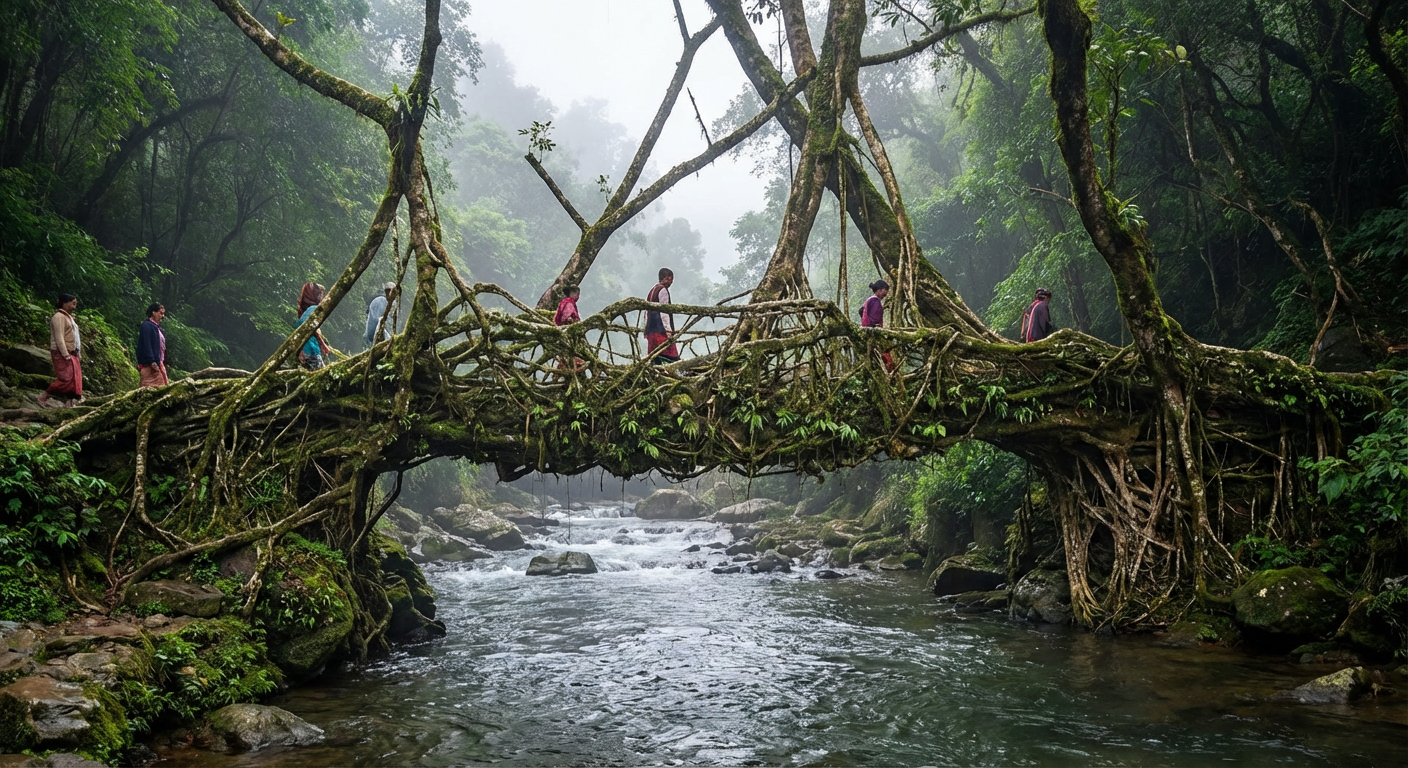
Beyond the cleanliness, Mawlynnong is surrounded by lush forests and living root bridges, which are exactly what they sound like.
Over decades, locals have trained the roots of rubber trees to grow across rivers, creating natural bridges that get stronger with age.
The nearby Dawki River is so clear that boats look like they’re floating in mid-air. It’s a small village, so you can see everything in a day or two, but the experience of being in such a well-maintained, community-focused place stays with you.
5) Gokarna, Karnataka
Gokarna is what Goa used to be before it became a party destination. It’s a small temple town on the coast with beautiful beaches that still feel relatively untouched.
Om Beach, Paradise Beach, and Half Moon Beach are all accessible by foot or boat, and they attract a laid-back crowd of travelers who want to relax without the noise.
The town itself has a spiritual side, with ancient temples and pilgrims who come for religious reasons. This mix of sacred and secular gives Gokarna a different vibe from typical beach towns.
You can spend your mornings doing yoga on the beach, your afternoons swimming or exploring tide pools, and your evenings watching the sunset with minimal crowds. Accommodations range from basic beach huts to more comfortable guesthouses, so you can choose your level of rustic.
6.) Spiti Valley, Himachal Pradesh
Spiti Valley is a high-altitude desert that looks more like Tibet than typical Indian landscapes. The valley is stark and beautiful, with barren mountains, ancient monasteries perched on cliffs, and villages that seem impossibly remote.
The air is thin, the roads are rough, and the weather can change without warning, but that’s part of what makes Spiti special.
Key Monastery is the largest and most famous, sitting on a hilltop with views that stretch for miles. Tabo Monastery is over a thousand years old and contains murals and sculptures that are still remarkably preserved.
The villages of Kaza, Langza, and Kibber offer homestays where you can experience local life firsthand. Spiti is not an easy place to visit, especially if you’re not used to high altitudes, but it rewards those who make the effort with landscapes and experiences that feel otherworldly.
7) Chettinad, Tamil Nadu
Chettinad is a region in Tamil Nadu known for its distinctive architecture and some of the best food in India.
The Chettiar community built grand mansions here during their trading heyday, and many of these homes still stand, filled with intricate woodwork, Belgian glass, and Italian marble.
Some have been converted into heritage hotels, while others sit quietly in small villages, slowly weathering with time.
The food here deserves its own mention. Chettinad cuisine is bold, spicy, and complex, with dishes that use freshly ground spices and techniques passed down through generations. You can take cooking classes, visit local markets, or simply eat your way through the region.
The area doesn’t get many international tourists, so you’ll likely be one of the few outsiders exploring these beautiful old towns and tasting food that hasn’t been adapted for tourist palates.
8) Gurez Valley, Jammu and Kashmir
Gurez Valley is one of the most remote and least visited valleys in Kashmir. It sits near the Line of Control, which means it requires special permits and hasn’t been developed for tourism the way other parts of Kashmir have.
The valley is stunningly beautiful, with the Kishanganga River running through it and snow-capped peaks on all sides.
The people here are Dard Shins, an ethnic group with their own language and customs distinct from the rest of Kashmir. The wooden houses, the way of life, and even the landscape feel different from what you’ll find elsewhere in the region.
Gurez is cut off by snow for much of the year, so it’s only accessible during the summer months. The isolation has preserved both the environment and the culture in ways that feel rare. If you want to see a side of Kashmir that almost no one talks about, this is it.
9) Dhanushkodi, Tamil Nadu
Dhanushkodi is a ghost town at the southern tip of India, where the Bay of Bengal meets the Indian Ocean. A cyclone destroyed most of the town decades ago, and it was never rebuilt.
What remains are ruins of a railway station, a church, and scattered buildings slowly being reclaimed by sand and sea.
The beach here is long, wide, and hauntingly beautiful. The water is shallow for a long stretch, and you can walk far out before it gets deep. The sense of isolation is strong, even though it’s technically accessible by road from Rameswaram.
Locals will tell you stories about the town’s past, and there’s a certain melancholy beauty to standing among the ruins with nothing but ocean and sky around you.
It’s not a place for typical beach activities, but if you appreciate places with history and atmosphere, Dhanushkodi will leave an impression.
10) Tawang, Arunachal Pradesh
Tawang sits at over 10,000 feet in the eastern Himalayas, close to the borders with Bhutan and Tibet. The town is dominated by Tawang Monastery, the largest Buddhist monastery in India and the second largest in the world.
The monastery is active, with hundreds of monks living and studying there, and visitors are welcome to observe prayers and explore the complex.
Beyond the monastery, Tawang offers mountain landscapes that rival anything in Ladakh or Sikkim. Sela Pass, on the way to Tawang, is often covered in snow and dotted with frozen lakes.
The local Monpa people have a distinct culture, and you’ll see their influence in the food, crafts, and festivals. Getting to Tawang requires permits and a long drive through winding mountain roads, but the town feels worth the effort.
It’s a place where spirituality, nature, and culture come together in a way that’s hard to find elsewhere.
India has no shortage of places that will surprise you if you’re willing to look beyond the main tourist trail.
These destinations offer something different, whether it’s dramatic landscapes, deep cultural roots, or simply the chance to travel without bumping into crowds at every turn. Each place on this list has its own character and its own rewards.
Pick one or two that speak to you, do a bit of planning, and go see what you find. The best travel stories often come from the places you didn’t expect.